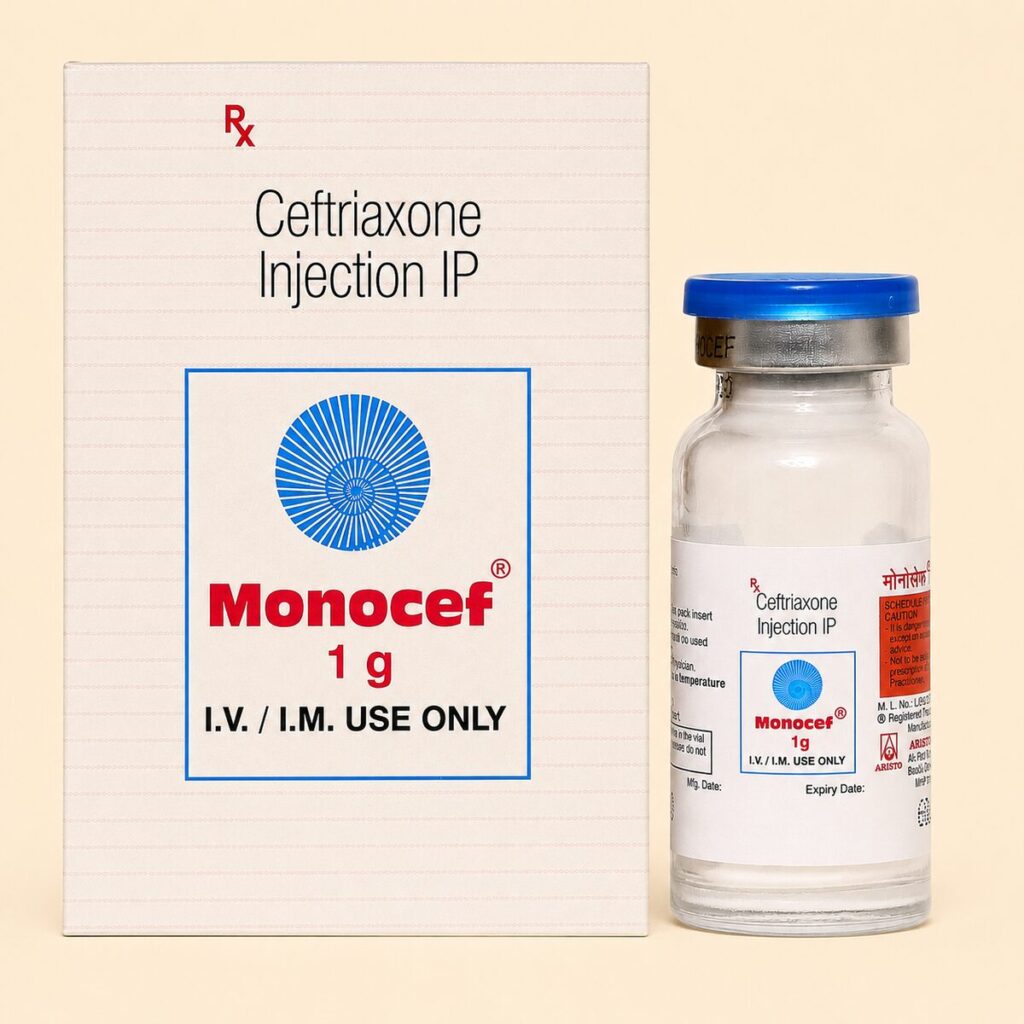
| Active Ingredient | Ceftriaxone |
| Manufacturer | Aristo Pharmaceuticals Pvt. Ltd. |
| Packaging | 1 vial |
| Strength | 1g (1000mg) |
| Delivery Time | 14-16 Days |
| SKU | 25 |
| Pack | Price | Qty | Add |
|---|---|---|---|
| 10 Injection | $80.00 | ||
| 20 Injection/s | $170.00 | ||
| 30 Injection/s | $250.00 | ||
| 40 Injection/s | $320.00 |
Monocef Ceftriaxone 1 gm Injection is a broad-spectrum injectable cephalosporin antibiotic used in hospital and clinical settings for the treatment of serious bacterial infections. Ceftriaxone — its active ingredient — is one of the most widely used third-generation cephalosporins in modern medicine, valued for its extended half-life allowing convenient once or twice daily dosing in many clinical situations.
The Monocef brand by Aristo Pharmaceuticals is a well-recognized formulation in clinical practice, used for infections requiring parenteral (injectable) antibiotic therapy where oral antibiotics are insufficient or not appropriate.
Ceftriaxone is not effective against viral infections such as colds, flu, or COVID-19. Using antibiotics inappropriately contributes to antibiotic resistance.
Monocef Ceftriaxone 1gm Injection is manufactured by Aristo Pharmaceuticals Pvt. Ltd., a well-established pharmaceutical company in India producing a wide range of injectable and oral medicines. The manufacturing facility operates in compliance with recognized Good Manufacturing Practice (GMP) standards.
Aristo Pharmaceuticals applies rigorous quality control procedures throughout raw material sourcing, sterile manufacturing processes, potency testing, sterility assurance, and final vial packaging. Each Monocef 1g vial undergoes comprehensive quality evaluation to ensure sterility, dosage accuracy, stability, and safety for parenteral administration.
The product is supplied as a sterile powder for injection in single vials intended for reconstitution and I.V. or I.M. administration by a healthcare professional.
Ceftriaxone works through a bactericidal mechanism that directly kills susceptible bacteria.
Ceftriaxone is active against a broad range of gram-positive and gram-negative bacteria including many strains resistant to older antibiotics.
| Commonly Use | Details |
| Respiratory Tract Infections | Community-acquired and hospital-acquired pneumonia caused by susceptible bacteria. |
| Bacterial Meningitis | One of the most established indications for Ceftriaxone in treating bacterial meningitis. |
| Bloodstream Infections | Septicemia and other bloodstream infections caused by susceptible organisms. |
| Complicated Urinary Tract Infections (UTIs) | Including pyelonephritis and other severe urinary tract infections. |
| Intra-abdominal Infections | Such as peritonitis and biliary tract infections. |
| Bone and Joint Infections | Including osteomyelitis and septic arthritis. |
| Pelvic Inflammatory Disease (PID) | Used in appropriate clinical situations as part of recommended treatment. |
| Uncomplicated Gonorrhea | Single-dose treatment for susceptible Neisseria gonorrhoeae infections. |
| Surgical Prophylaxis | Prevention of post-surgical bacterial infections in selected procedures. |
| Typhoid Fever | May be prescribed in appropriate clinical situations for susceptible Salmonella Typhi infections. |
Monocef Ceftriaxone 1 gm Injection must be prepared and administered by a qualified healthcare professional. It is not intended for self-administration under any circumstances.
Administration involves:
The appropriate dose depends on several individual clinical factors:
Only a qualified healthcare professional can determine the correct dose, route, frequency, and duration.
As a general clinical reference for adults:
Pediatric dosing is weight-based and determined by the treating physician. Dose adjustments may be needed in patients with significant kidney or liver impairment.
Not all patients experience side effects.
Commonly reported:
Less commonly reported:
Seek immediate medical attention if:
🚨 Severe allergic reaction — facial or throat swelling, difficulty breathing, widespread hives or flushing
🚨 Severe or persistent diarrhea — may indicate Clostridioides difficile-associated infection
🚨 Severe skin reactions — blistering, peeling, or painful widespread rash
🚨 Signs of kidney or liver problems — reduced urine output, swelling, jaundice
🚨 Gallbladder symptoms — abdominal pain or vomiting, as Ceftriaxone can occasionally cause biliary sludge
The treating healthcare team must be informed of all medicines, supplements, and treatments being used.
Q: What is Monocef Ceftriaxone 1 gm Injection used for?
A: Healthcare professionals prescribe it for serious bacterial infections including pneumonia, meningitis, complicated urinary tract infections, bloodstream infections, bone and joint infections, gonorrhea, and surgical prophylaxis among other clinical indications.
Q: Can Monocef Injection be self-administered at home?
A: No. Monocef 1g Ceftriaxone Injection must be prepared and administered by a licensed healthcare professional in an appropriate clinical setting. It is not suitable for home self-administration.
Q: What is the difference between Monocef and generic Ceftriaxone?
A: Monocef is the well-established branded formulation of Ceftriaxone by Aristo Pharmaceuticals. Both contain the same active ingredient — Ceftriaxone — at the same 1g strength. Monocef is widely used and clinically trusted in Indian and international medical practice.
Q: Can Ceftriaxone treat viral infections?
A: No. Ceftriaxone is only effective against susceptible bacterial infections. It has no activity against viruses such as those causing colds, flu, or COVID-19.
Q: Is Monocef safe if I have a penicillin allergy?
A: Inform your healthcare provider about any known penicillin or cephalosporin allergy before receiving this injection. A small percentage of patients with penicillin allergy may also react to cephalosporins.
Q: Why must Ceftriaxone not be mixed with calcium-containing IV solutions?
A: Mixing Ceftriaxone with calcium-containing IV fluids can cause formation of insoluble particles. This is particularly dangerous in newborns and must be strictly avoided.
Q: How is Monocef 1g administered — I.V. or I.M.?
A: Monocef 1g can be administered via either intravenous (I.V.) infusion or intramuscular (I.M.) injection depending on clinical need. The route is determined by the treating physician.
Q: How should Monocef Ceftriaxone 1 gm Injection be stored?
A: Store unreconstituted vials at room temperature below 25°C away from sunlight and moisture in original packaging. Do not freeze. Use reconstituted solution promptly. Keep out of reach of children.
Medical Disclaimer: The information shown above is for educational purposes only. Please consult your doctor or a licensed healthcare professional before taking any medicine. Never start, stop, or change any treatment without professional medical advice.

Reviews
There are no reviews yet.